
Turns Out You Need to Know Where You Started
Until recently, I couldn’t have told you whether anything we were doing at Riverdale Farm was working.
My partner and I have poured ourselves into this property. We plant, we restore, we care. But in the second session of the Saving Species: For Landholders and Farmers course at Odonata Academy, it clicked. Without a baseline and monitoring, our work had little meaning. We had no idea what we were really doing, or whether it was working. We were acting on good intentions and hoping.
We’re doing the course together, one of 15 landholders learning how to conserve our land and the species on it. Every fortnight we hear from someone new at Odonata, and every time I come away in awe. They are gifted, talented and humble people, doing extraordinary things to save species.
The second session was on ecosystem baselining and monitoring: why it matters, how to use data to shape restoration goals around what a particular site needs, which environmental metrics to track, and when and how to use different methods.
The person leading it was Georgia Randall, Program Ecologist at Odonata. Georgia is completing her PhD at Deakin University, in partnership with Odonata, on the role of native mammals in carbon cycling and ecosystem restoration. She’s exploring how saving species can deliver conservation and climate benefits together, and that’s exactly the kind of thinking we need more of.
Her work is groundbreaking.
Out of that session came our plan: the Riverdale Farm Biodiversity Monitoring Matrix. It sets out, in one place, what we’ll measure, how, how often, and what we need to get it done. It’s built in two levels (see matrix below):
Ecosystem condition is where we start. It’s photo-points that anyone can do with a phone, quadrat sampling using the COVRAM app, and an annual bird count with the Birds SA team.
Ecosystem composition goes deeper: trail cameras, invertebrate and reptile surveys, bio-acoustic monitoring, and water quality. We’ll also be looking for frogs, turtles, dragonflies and damselflies through FrogID, TurtleSAT and dragonfly and damselfly surveys.
I’ll be honest: some of it is still a work in progress but got slightly ahead of the plan. I bought a bioacoustic monitor. I bought the cameras. My partner has set up the insect traps. And I am totally distracted by iNaturalist, and I now have a very good excuse to photograph and identify absolutely everything that moves, flies, crawls or sits still on the property.
What I didn’t expect is how much I’d love it. Monitoring turns out not to be a chore that sits beside the restoration work. It’s what makes the work mean something. It gives the farm a way of answering back.
I’ll be sharing much more on the course in the weeks ahead. If you’re a landholder or farmer who wants to do more for threatened species on your land, have a look at Saving Species: For Landholders and Farmers at Odonata Academy.
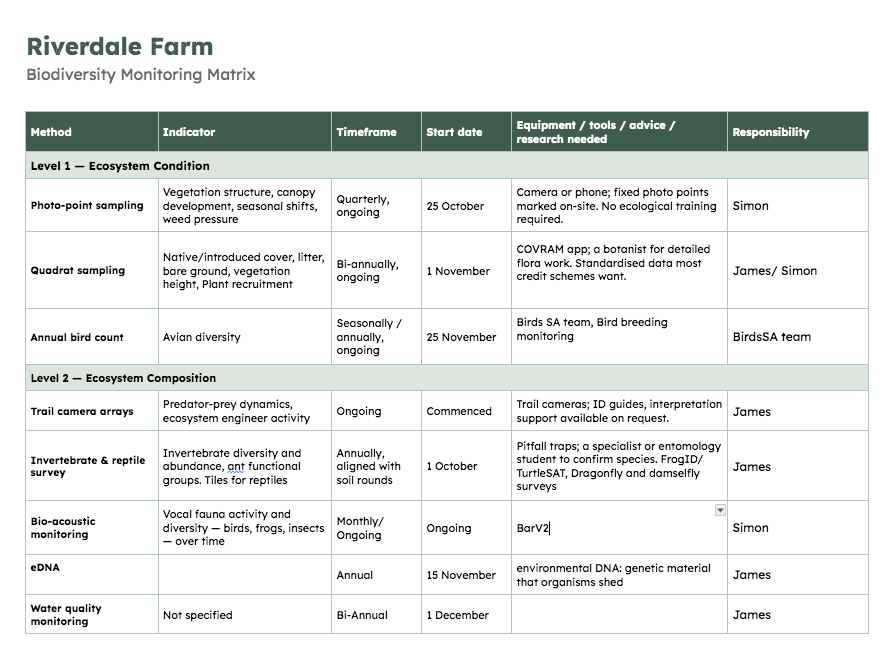
Riverdale Biodiversity Monitoring Matrix
