
Learning to listen
The morning began at four.
Not with an alarm, but with a quiet sense that something important was about to happen.
The house was full of people — friends, travellers, kindred spirits — all fumbling for boots and mugs of coffee in the dark. We were heading out to Monarto Woodlands to meet at five, to sit and listen to the dawn chorus. Not to identify birds or collect data. Just to listen.
When we arrived, the first call was the Hooded Robin. The air was still, the light not yet formed. A few of us sat together in silence — my friend Janet beside me — and for an hour and fifteen minutes we simply listened.
There were Spiny-cheeked Honeyeaters and Cuckoos, Grey Shrike-thrushes, Robins. The occasional plane overhead, the freeway in the distance, and beyond that, the wild pulse of life waking up. The sound was so rich, so layered, that I stopped trying to name what I was hearing. I just let it wash through.
It’s a strange thing, to really listen. We think we do it all the time, but mostly we’re scanning — searching for what we already know, trying to make sense of what’s useful to us. True listening requires a surrender of that. It’s a way of participating rather than observing. Of being porous.
The workshop was led by Andrew Skeoch, an acoustic ecologist who has spent years recording soundscapes around the world. He calls his work deep listening to nature. There’s no mysticism to it — just attention. He invited us to notice not only what we could hear, but how we were hearing: the quality, direction, and texture of sound.
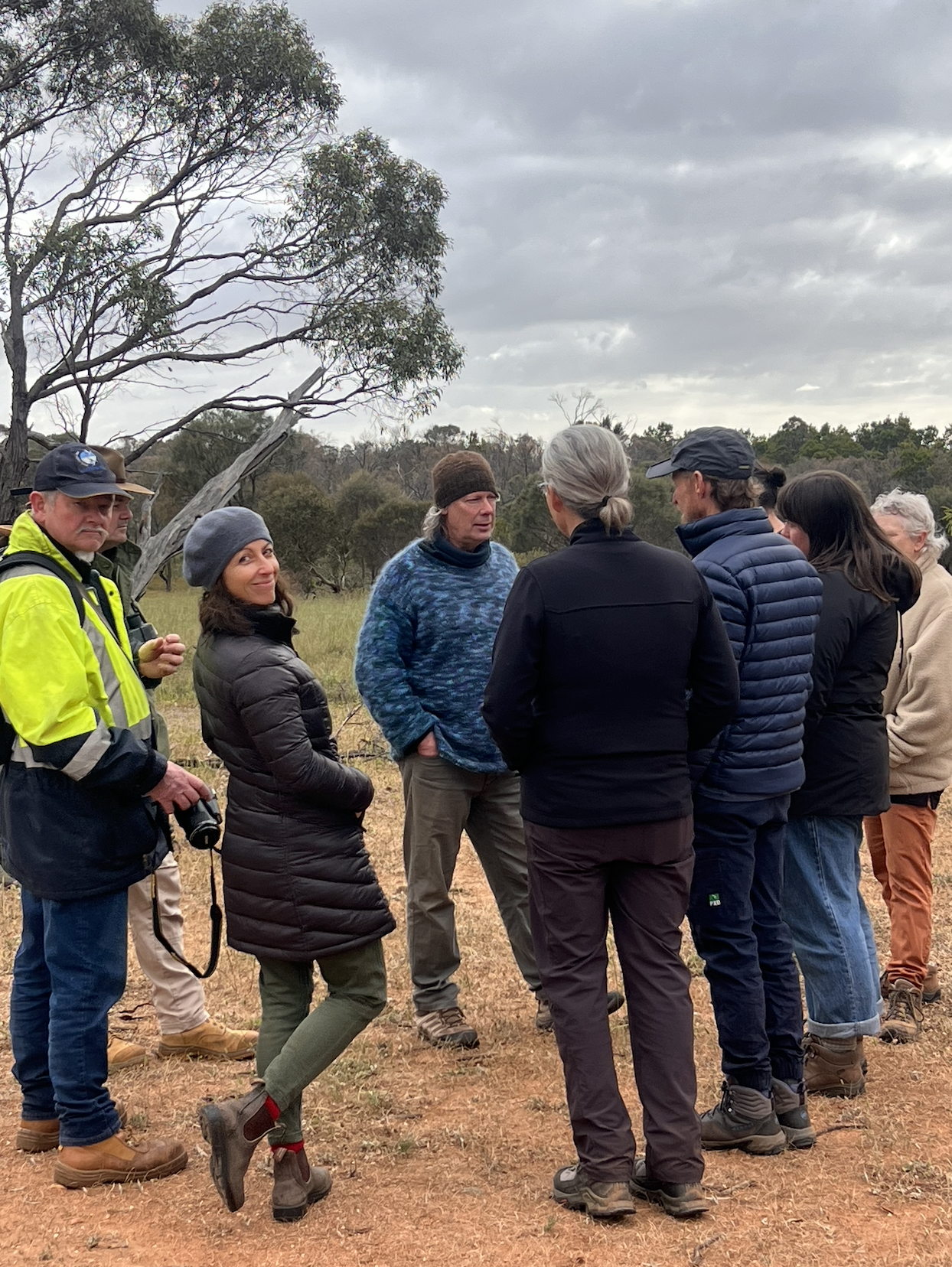
Out in Monarto Woodlands after the dawn chorus
Later, when the sun rose, Andrew asked us to go off on our own and listen to a single bird. To return with its song translated into a string of human sounds — nonsense syllables that might capture its rhythm or mood. I found a few Grey Shrike-thrushes calling from the trees and returned with a strange mix of hums and chirps. We laughed, but it felt like something more was happening — as if by mimicking their song, I was briefly part of it.
That, I think, was the point: listening not as a tool for knowing, but as a way of belonging.
Andrew spoke about how listening gives us live information. I love that phrase.
When you listen, you’re receiving what’s happening right now. You hear birds feeding or fighting, frogs calling after rain, wind carrying scent through leaves. It’s the land speaking in real time — a living, breathing intelligence that’s easy to miss if you’re only looking.
Sight, I’m realising, is always a fraction behind. It shows us what has already happened. But sound is present tense.
For someone like me, who spends so much of life outside— farming, restoring, rewilding — this feels like a quiet revelation. If we listened first, before we acted, could the land tell us what it needs? When it’s resting? When it’s ready? When it’s full or struggling?
I don’t have answers, only a longing to explore this more deeply. Listening might be the first step in renaturing — not the act of planting or fencing or managing, but of hearing what’s already there.
Just as we were finishing the workshop, a cry lifted through the sky above us — a high, looping call. I knew it immediately: Rainbow Bee-eaters. They return every year to our farm from Papua New Guinea, almost always on the same day. Hearing them felt like the land itself was marking the moment, reminding me that everything moves in rhythm.
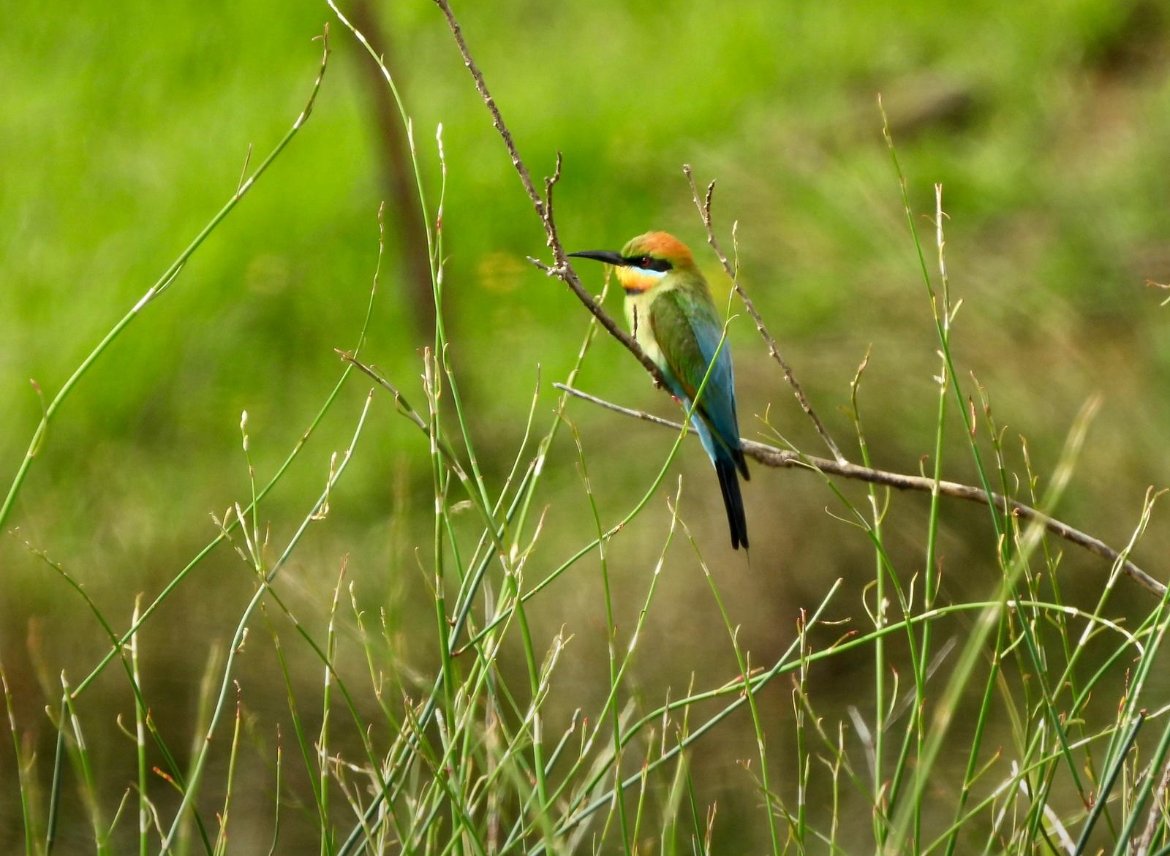
Rainbow bee-eater by the river
They are back. The cycle continues.
Since that morning, I’ve found myself tuning in differently.
I still listen for birds — I always have — but I’m beginning to listen for what sits behind them: the wind, the hum of insects, the long pauses between calls. The spaces are as revealing as the sounds.
Listening, in this way, could become a practice of care. A compass for restoration. A way of remembering that we are not managing the land — we are in conversation with it.
The difference between a morning alive with insects and one that’s strangely quiet; the way frog calls might rise after rain when the river flows again; the change in tone as wind moves through young native grasses compared to the dry rustle of older paddocks. I want to learn what these sounds might reveal about health and rhythm — to hear when the land is breathing well, and when it’s struggling to catch its breath.
I don’t think I really know yet what it means to “listen to the land.” I have a vague understanding, yes, but mostly I have questions.
Listening might be the way back into relationship — a way to relearn cooperation, with each other and with the living world around me.
The more I listen, the more I realise how much I’ve missed.
